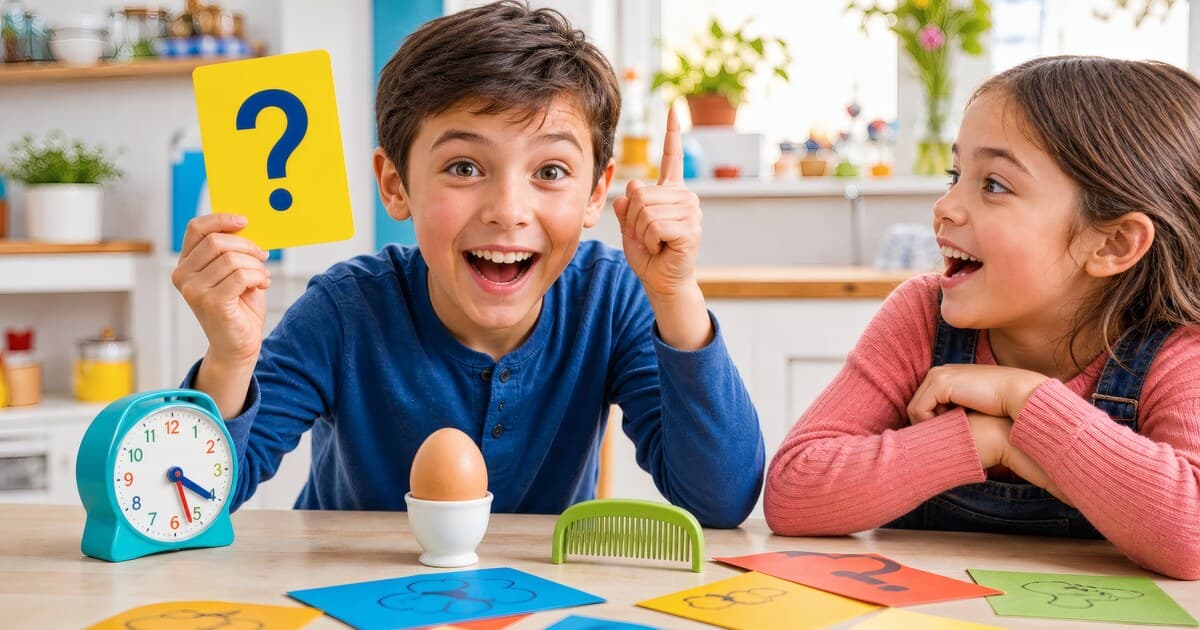
The best riddles for kids have one thing in common: the answer is something kids already know it is just hidden behind a question they have never thought about. What has teeth. Cannot bite? A five year old kid has a comb. They have just never been asked to think about a comb. That little surprise of I knew that. Did not see it is the whole magic. It is why riddles are still fun for every generation of kids who play with screens.
Most lists of riddles just give you a lot of riddles. You have to guess which ones your kid will like. This list is different because it is sorted by age first like kids who're 4 to 6 years old kids who are 7 to 9 years old and kids who are 10 to 12 years old. The reason is that a riddle that is fun for a kindergartner kid is boring for a fifth grader kid and a riddle with wordplay that is meant for a ten year kid is frustrating for a six year old kid. After the age groups you will find sections for math riddles for kids, animal riddles for kids, riddles for kids and brain buster riddles for kids, which can be used to mix things up plus what we learned about telling riddles for kids without making the younger kids cry.
Answers are in bold after each riddle for kids so you can look and pick before you say anything out loud, to your kid.
Riddles for ages 4–6
At this age, pick riddles about physical objects they can picture, and let them shout wrong answers freely. Wrong answers are the fun part.
- What has hands but can't clap? A clock.
- What has to be broken before you can use it? An egg.
- What gets wetter the more it dries? A towel.
- I'm tall when I'm young and short when I'm old. What am I? A candle.
- What has teeth but cannot bite? A comb.
- What has one eye but can't see? A needle.
- What kind of band never plays music? A rubber band.
- What has legs but never walks? A table.
- What has a neck but no head? A bottle.
- What goes up but never comes down? Your age.
- What can you catch but never throw? A cold.
- What has ears but cannot hear? Corn.
- What is full of holes but still holds water? A sponge.
- What falls in winter but never gets hurt? Snow.
- What room has no doors or windows? A mushroom.
- What kind of tree fits in your hand? A palm tree.
- What has a thumb and four fingers but isn't alive? A glove.
- What kind of lion never roars? A dandelion.
- What goes up when the rain comes down? An umbrella.
- What animal can jump higher than a house? Any animal — houses can't jump.
Riddles for ages 7–9
Readers now, and starting to enjoy words as things. Letter riddles and double meanings hit hard here.
- How many months of the year have 28 days? All of them.
- What travels around the world but stays in one corner? A stamp.
- What gets bigger the more you take away from it? A hole.
- What can you keep after giving it to someone? Your word.
- What begins with T, ends with T, and has T in it? A teapot.
- The more of this there is, the less you see. What is it? Darkness.
- What has 13 hearts but no other organs? A deck of cards.
- Which building has the most stories? The library.
- What invention lets you look right through a wall? A window.
- Where does today come before yesterday? In the dictionary.
- What's black and white and read all over? A newspaper.
- What has many keys but can't open a single lock? A piano.
- What can fill a room but takes up no space? Light.
- If you drop me, I'm sure to crack. Give me a smile and I'll always smile back. A mirror.
- What goes up and down but never moves? A staircase.
- Which word is spelled wrong in every dictionary? "Wrong."
- What kind of coat is best put on wet? A coat of paint.
- What has words but never speaks? A book.
- What breaks as soon as you say its name? Silence.
- What five-letter word becomes shorter when you add two letters to it? Short.
Riddles for ages 10–12
Old enough for misdirection and multi-step logic. Also old enough to turn the riddles back on you at dinner.
- I'm light as a feather, but the strongest person can't hold me for five minutes. Your breath.
- Forward I am heavy; backward I am not. What am I? A ton.
- What is always in front of you but can't be seen? The future.
- A cowboy rides into town on Friday, stays three days, and leaves on Friday. How? His horse is named Friday.
- What belongs to you, but other people use it more than you do? Your name.
- I am an odd number. Take away a letter and I become even. Seven.
- David's parents have three sons: Snap, Crackle, and…? David.
- If you have me, you want to share me. If you share me, you no longer have me. A secret.
- What has cities but no houses, forests but no trees, and rivers but no water? A map.
- What comes once in a minute, twice in a moment, but never in a thousand years? The letter M.
- What tastes better than it smells? Your tongue.
- Feed me and I live. Give me a drink and I die. Fire.
- How do you spell "railroad crossing, no cars" without any Rs? N-O C-A-R-S.
- What word has 26 letters but only three syllables? The alphabet.
- What can go through glass without breaking it? Light.
- You use me every day, but you change all of me every month. A calendar.
- What is at the end of every rainbow? The letter W.
- You see me once in June, twice in November, and not at all in May. The letter E.
- What question can you never honestly answer "yes" to? "Are you asleep?"
- What loses its head every morning and gets it back every night? A pillow.
Math riddles for kids
These sneak real arithmetic and logic into joke form. Teachers, these make excellent board warm-ups next to a printable puzzle.
- If two's company and three's a crowd, what are four and five? Nine.
- What three numbers give the same result whether you add them or multiply them? 1, 2, and 3.
- What did the zero say to the eight? "Nice belt!"
- There are 4 apples on the table. You take away 3. How many apples do you have? Three — you took them.
- How many times can you subtract 10 from 100? Once. After that you're subtracting from 90.
- Two fathers and two sons each ate one apple, but only three apples were eaten. How? They were a grandfather, a father, and a son.
- Which weighs more: a pound of feathers or a pound of bricks? Neither — both weigh a pound.
- A rooster lays an egg on the exact top of a barn roof. Which way does it roll? It doesn't — roosters don't lay eggs.
- How do you make the number 7 even without adding or subtracting? Take away the S.
- Which number has all its letters in alphabetical order? Forty.
- My tens digit is five more than my ones digit, and my hundreds digit is eight less than my tens digit. What number am I? 194.
- When things go wrong, what can you always count on? Your fingers.
- Multiply me by any number and the answer stays the same. What am I? Zero.
- A duck is paid $9, a spider $36, and a bee $27. How much does a cat get? $18 — everyone earns $4.50 per leg.
- Mary's father has five daughters: Nana, Nene, Nini, Nono, and…? Mary.
Animal riddles for kids
- What do you call a fish without an eye? A fsh.
- I have no sword, but I carry a thousand needles. A porcupine.
- Which animal is always found at baseball games? A bat.
- Why can't a leopard ever hide? Because it's always spotted.
- What do you get from a pampered cow? Spoiled milk.
- Which bird can lift the heaviest weight? A crane.
- I'm black and white and loved all over the world. A panda.
- What kind of key can never open a door? A monkey (or a donkey, or a turkey).
- Why do bees have sticky hair? Because they use honeycombs.
- What do you call a sleeping bull? A bulldozer.
- I carry my house with me wherever I go. A snail.
- Why are fish so smart? They live in schools.
- Which bird should probably wear a wig? The bald eagle.
- Where do cows go on Friday night? To the moo-vies.
- I sleep all day and fly all night, but I have no feathers. A bat.
Funny riddles for kids
The groaners. In our experience these are the ones kids memorize instantly and repeat for six straight weeks. Consider yourself warned.
- What has four wheels and flies? A garbage truck.
- Why did the student eat his homework? The teacher said it was a piece of cake.
- What did one ocean say to the other? Nothing — it just waved.
- What's brown and sticky? A stick.
- Why did the bicycle fall over? It was two-tired.
- What kind of shoes do ninjas wear? Sneakers.
- Why was 6 afraid of 7? Because 7 8 9.
- What do you call cheese that isn't yours? Nacho cheese.
- Why do cows wear bells? Because their horns don't work.
- What did the traffic light say to the car? "Don't look — I'm changing."
- What washes up on very small beaches? Microwaves.
- Why did the golfer bring two pairs of pants? In case he got a hole in one.
- Where do pencils go on vacation? Pennsylvania.
- What's orange and sounds like a parrot? A carrot.
- Why did the cookie go to the doctor? It was feeling crummy.
- What do elves learn in school? The elf-abet.
- Why don't eggs tell each other jokes? They'd crack up.
- What did the big flower say to the little flower? "Hey, bud."
- What does a cloud wear under its raincoat? Thunderwear.
- How does a scientist freshen her breath? With experi-mints.
Brain busters (the hard ten)
Save these for kids who beg for "a really hard one." Read slowly, and give one hint before revealing anything.
- A man was outside in the rain with no umbrella and no hat, yet not a single hair on his head got wet. How? He was bald.
- The more you take, the more you leave behind. Footsteps.
- What has one head, one foot, and four legs? A bed.
- I speak without a mouth and hear without ears. What am I? An echo.
- A girl fell off a 20-foot ladder but wasn't hurt at all. Why? She fell off the bottom rung.
- What gets sharper the more you use it? Your brain.
- What can you hold in your left hand but never in your right? Your right elbow.
- What five-letter word sounds exactly the same after you remove four of its letters? Queue.
- What two things can you never eat for breakfast? Lunch and dinner.
- A truck driver goes the wrong way down a one-way street past two police officers, and neither stops him. Why? He's walking.
How to actually run riddles with kids (without tears)
We've done riddle rounds at birthday parties, long car rides, and one memorably delayed flight, and the same three rules keep saving us:
- Wrong answers get celebrated. The moment a wrong guess gets laughed at instead of with, younger kids stop guessing. Say "ooh, close!" even when it isn't.
- Hints beat reveals. Kids get far more from "it's something in the kitchen" than from hearing the answer. Aim for three hints before you ever reveal.
- Let them stump you. Deliberately "struggle" with a riddle they ask you. A seven-year-old who beats an adult at a riddle will demand riddles for a month — which is exactly the goal.
For classrooms: riddles slot perfectly into the same five-minute warm-up window as a quick puzzle. If you already run puzzle warm-ups, our 10-minute word search warm-up plan shows the structure, and you can build vocabulary versions of it with the puzzle maker.
Prefer to watch a round in action first? This family riddle video is a good format to steal for game night:
Why riddles are quietly great for kids' brains
Riddles force a specific mental move: holding two meanings of one phrase at the same time, then discarding the obvious one. Researchers who study children's humor have long noted that riddle comprehension tracks closely with the development of language flexibility around ages 6–8: kids start getting riddles at roughly the same time they can handle words having double meanings at all (the classic work here is McGhee's research on children's humor). In practice, that means riddles are a stealth reading-comprehension exercise a kid will voluntarily do in the back seat of a car.
Keep the streak going
When your kid burns through all 120 (it happens faster than you'd think), the natural next steps are a round of hangman with words from the riddles they just solved, our rebus puzzles with answers (numbers 1–15 are perfect for the 7–9 band), or a custom word search built from their favorite riddle answers. And once they start asking for "grown-up ones," send them to riddles for adults. Supervised, since a few of those are proper stumpers.