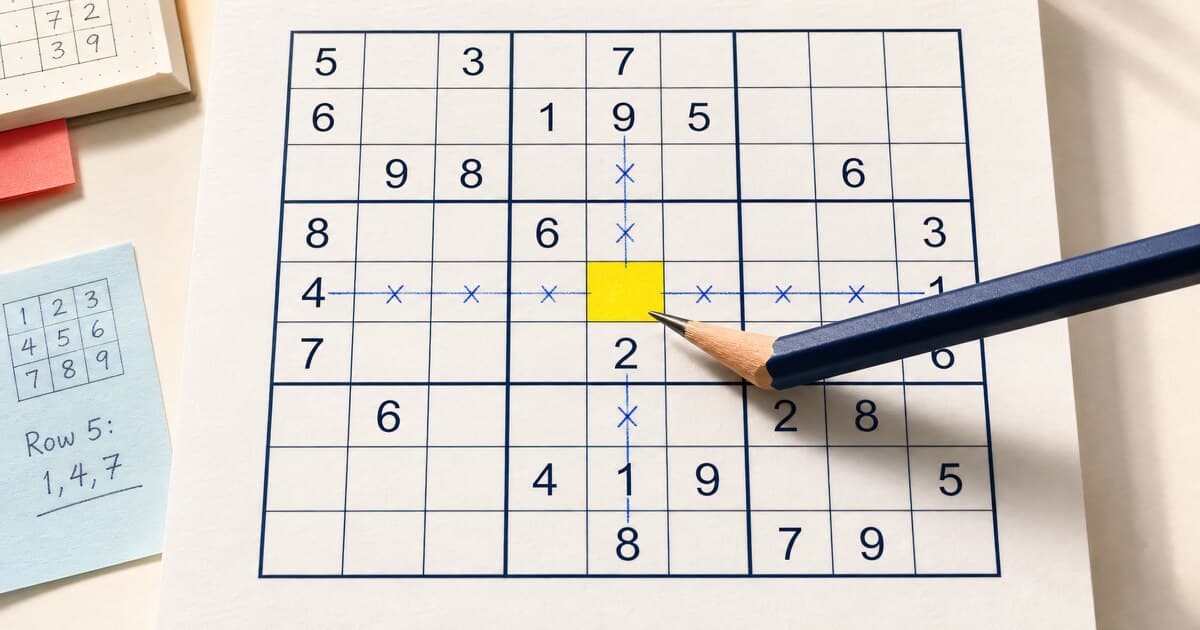
If you want to learn how to play sudoku you only need to remember three rules. And none of them involve math. You never add, subtract or calculate anything. Sudoku is logic, which is why a puzzle printed in Japanese Spanish or English plays exactly the same.
This guide takes you from "what's this grid" to solving real puzzles: the rules, where to find your first number, the exact techniques that crack easy, medium and hard puzzles and the two mistakes that quietly ruin more grids than anything else. When you are ready to practice our free online sudoku has puzzles at every difficulty and the printable sudoku collection works if you would rather solve on paper. Which honestly is how most of us on the team still prefer it.
The three rules of sudoku
A sudoku grid is 9 cells wide and 9 cells tall. 81 Cells total. Divided into nine 3×3 boxes. Some cells arrive pre-filled. Those are called givens. They never change. Your job is to fill every empty cell with a digit from 1 to 9 so that:
- Every row contains 1 through 9 with no repeats.
- Every column contains 1 through 9 with no repeats.
- Every 3×3 box contains 1 through 9 with no repeats.
That's the entire rulebook. Every digit you place must satisfy all three rules at once, because every cell belongs to exactly one row, one column, and one box.
One more thing worth knowing before you start: a properly made sudoku has exactly one solution, and you can reach it by logic alone. You never need to guess. If you feel like you have to guess, you've missed a deduction somewhere. That reframe alone will make you a better solver.
Reading the grid: a 60-second vocabulary lesson
You'll see these terms in every sudoku guide, including the rest of this one:
| Term | Meaning |
|---|---|
| Cell | One of the 81 squares |
| Row | 9 cells running left to right |
| Column | 9 cells running top to bottom |
| Box (or block) | One of the nine 3×3 regions |
| Given | A digit printed in the starting grid |
| Candidate | A digit that could legally go in a cell |
| Pencil marks | Small notes of candidates written in a cell's corner |
Your first move: scanning for forced numbers
Open any easy puzzle and the question is always the same: where do I even start? The answer is scanning, and it works best on whichever digit already appears most in the grid.
Say the grid shows six 5s. Pick a 3×3 box that doesn't have a 5 yet. The 5s already placed in neighboring rows and columns "shoot lines" through that box, eliminating cells. If those lines eliminate every cell but one, the remaining cell must be the 5. That technique is called crosshatching, and easy puzzles can be solved with almost nothing else.
Here's a complete example. Look at the top-left box (rows A–C, columns 1–3) and follow the existing 5s across their rows and down their column:
Crosshatching a 5
Why C3 is the only legal cell
- The 5 in A5 eliminates row A from the top-left box.
- The 5 in B4 eliminates row B.
- The 5 in D1 eliminates C1 by column.
- C2 already contains 7, leaving C3 = 5.
One digit, placed by pure elimination. This is the exact scan you repeat across the other boxes and digits.
Repeat that scan for 1 through 9, and by the time you finish the pass, the new digits you placed will have unlocked spots that were dead ends five minutes ago. Easy puzzles collapse in two or three passes.
The technique ladder: what solves each difficulty
This is the part most beginner guides skip: they teach crosshatching, then wave vaguely at "harder techniques." Here's the actual ladder, in the order you should learn it. Each technique is enough to finish puzzles at its tier.
Level 1 — Naked singles (easy puzzles)
A naked single is a cell where eight of the nine digits are already blocked by its row, column, and box. Whatever digit remains is the answer. Late in any puzzle these appear constantly; on easy puzzles they appear from the start.
The reliable way to spot them: pick an empty cell in the most crowded region of the grid and count what it can still legally hold. If the answer is "one thing," write it in.
Level 2 — Hidden singles (easy/medium)
A hidden single hides in plain sight: the cell has several candidates, but one of those candidates has no other legal home in the row, column, or box. If the 4 can only go in one cell of a box, the 4 wins there, even when that cell could also hold a 2 or a 9. This is crosshatching formalized, and it's the single most-used deduction in all of sudoku.
Level 3 — Pencil marks and locked candidates (medium)
Around medium difficulty, you stop being able to hold the grid in your head. Start writing small candidate digits in cell corners. On paper, use a pencil. Our online sudoku has a notes mode that does the same thing without the eraser shavings.
Pencil marks enable locked candidates: when all of a box's possible spots for a digit fall in a single row or column, that digit is "locked", and you can erase it as a candidate from the rest of that row or column even though you don't know its exact cell yet. This is the first technique that eliminates candidates outside the region you're looking at, and it's the key that opens most medium puzzles.
Level 4 — Naked and hidden pairs (medium/hard)
If two cells in the same row share exactly the same two candidates (say both can only be 3 or 8), then the 3 and 8 live in those two cells, period. Erase 3 and 8 from every other cell in that row. That's a naked pair. The hidden version flips it: if 3 and 8 appear as candidates only in two cells of a region, those cells can't be anything else, so their other pencil marks vanish.
Level 5 — X-wing and beyond (hard/expert)
An X-wing looks at two rows where a digit has exactly two possible columns, and they are the same two columns in both rows. The four cells form a rectangle, the digit must occupy diagonal corners, and it disappears as a candidate everywhere else in those two columns. Past X-wing live swordfish, XY-wings, and chain techniques; if you get that deep, the Hodoku technique library is the best free reference we've found, with interactive examples of every pattern.
Don't rush the ladder. We've watched people bounce off sudoku because they jumped from easy puzzles to expert ones and concluded they "weren't smart enough", when the actual gap was two unlearned techniques.
A worked walkthrough of the opening
Puzzles differ, but strong openings follow the same script. Here's the routine we use on every fresh grid, in order:
- Count the givens per digit. A digit that appears 5+ times is your best scanning target; a digit that appears once is a dead end for now.
- Crosshatch the top digit through all nine boxes. Place anything forced.
- Repeat for the next-most-common digits. Every placement changes the board, so a digit that gave you nothing on the first pass often cracks on the second.
- Hunt naked singles in crowded areas. Any row, column, or box with 6+ digits filled probably contains one.
- When placements dry up, pencil-mark the emptiest boxes and switch to locked candidates and pairs.
The first three steps routinely fill 10–15 cells on an easy puzzle before you need to think hard at all.
If you prefer to see the rules in motion before solving, this 90-second explainer covers the basics visually:
The two mistakes that ruin more grids than anything else
Mistake 1: guessing. Penciling in a "probably" digit feels like progress. It isn't. One wrong guess propagates silently. Every deduction you build on top of it is poisoned, and you typically discover the contradiction 20 minutes later with no idea which of your last 30 digits caused it. The fix is a hard personal rule: never place a digit you can't justify out loud. "It's the only legal digit for this cell" or "it's the only legal cell for this digit" — if you can't say one of those sentences, keep scanning.
Mistake 2: stale pencil marks. Every digit you place invalidates candidates elsewhere. If you don't erase them, your own notes start lying to you, and you'll eventually "deduce" something from a candidate that died ten moves ago. On paper, update neighbors immediately after each placement. Online, auto-clearing notes handle this for you, which is genuinely the strongest argument for learning digitally before going to print.
A third, smaller one we see constantly: forgetting the box rule. New players check the row, check the column, and confidently place a digit that's already sitting two cells away in the same 3×3 box. When you're starting out, make the box your first check, not your last.
How difficulty actually works
A common misconception: hard puzzles have fewer givens. Not really. Difficulty mostly reflects which techniques the puzzle forces you to use:
| Difficulty | Typical givens | Techniques required | Realistic solve time (beginner) |
|---|---|---|---|
| Easy | 36–45 | Crosshatching, naked/hidden singles | 10–20 min |
| Medium | 30–35 | + pencil marks, locked candidates | 20–40 min |
| Hard | 25–30 | + naked/hidden pairs, triples | 40–90 min |
| Expert | 22–26 | + X-wing, XY-wing, chains | Hours, at first |
For the record, the mathematical minimum is 17 givens: researchers at University College Dublin proved in 2012 that no 16-given sudoku with a unique solution exists, by checking essentially all of them (McGuire, Tugemann & Civario). You'll likely never meet a 17-given puzzle in a newspaper, but it's a great trivia answer.
Our advice on progression: stay at easy until you finish three puzzles in a row without stalling, then move up one tier. Each tier should feel slightly uncomfortable. If you're stuck mid-grid and out of ideas, don't guess — check whether an unlearned technique from the ladder above is the missing key.
A 2-week practice plan that actually sticks
When one of our teammates taught their 68-year-old dad sudoku last winter, this is roughly the schedule that took him from "which numbers go where?" to finishing mediums with his morning coffee:
- Days 1–3: One easy puzzle per day. Use only scanning and singles. Don't time yourself.
- Days 4–7: Two easy puzzles per day. Start saying deductions out loud ("5 can't be in row A because…"). It feels silly and works absurdly well.
- Days 8–10: First medium puzzles. Learn pencil marks properly. Expect one DNF — that's normal.
- Days 11–14: One medium daily. Add locked candidates. By day 14, easy puzzles should feel almost automatic.
Fifteen focused minutes daily beats a two-hour weekend binge. Sudoku skill is pattern recognition, and pattern recognition compounds with frequency, not volume.
Frequently asked questions
Do I need to be good at math? No. The digits 1–9 are just nine distinct symbols. A sudoku made of nine different animals would play identically (and yes, kids' versions like that exist).
Is guessing ever okay? In a properly constructed puzzle, never necessary. Advanced solvers sometimes use disciplined trial-and-error (bifurcation) on brutal puzzles, but as a learning habit it teaches you nothing and corrupts grids. Build the deduction muscle first.
How long should a puzzle take? New solvers: 15–30 minutes on easy. Experienced solvers finish easies in under 5 and mediums in under 15. Speed arrives on its own; accuracy has to be built deliberately.
What if two digits both seem legal for a cell? Then the cell isn't ready. That's not ambiguity (a real sudoku has one solution). It means the information to decide isn't there yet. Solve elsewhere and come back.
Paper or screen? Learn online if you can: instant feedback catches rule violations before they cascade, and auto-notes remove the bookkeeping. Switch to printables when you want the no-notifications, pencil-on-paper version — several of us do our weekend puzzles that way exclusively.
Start with an easy one
The gap between reading about sudoku and being decent at it is about ten puzzles. Open a free sudoku, pick easy, and run the opening routine from this guide: count the givens, crosshatch the most common digit, and let the grid unravel from there.
And if sudoku ends up being your gateway puzzle, the logic muscles transfer. Our guides to word searches vs crosswords and riddles for adults are good next stops.