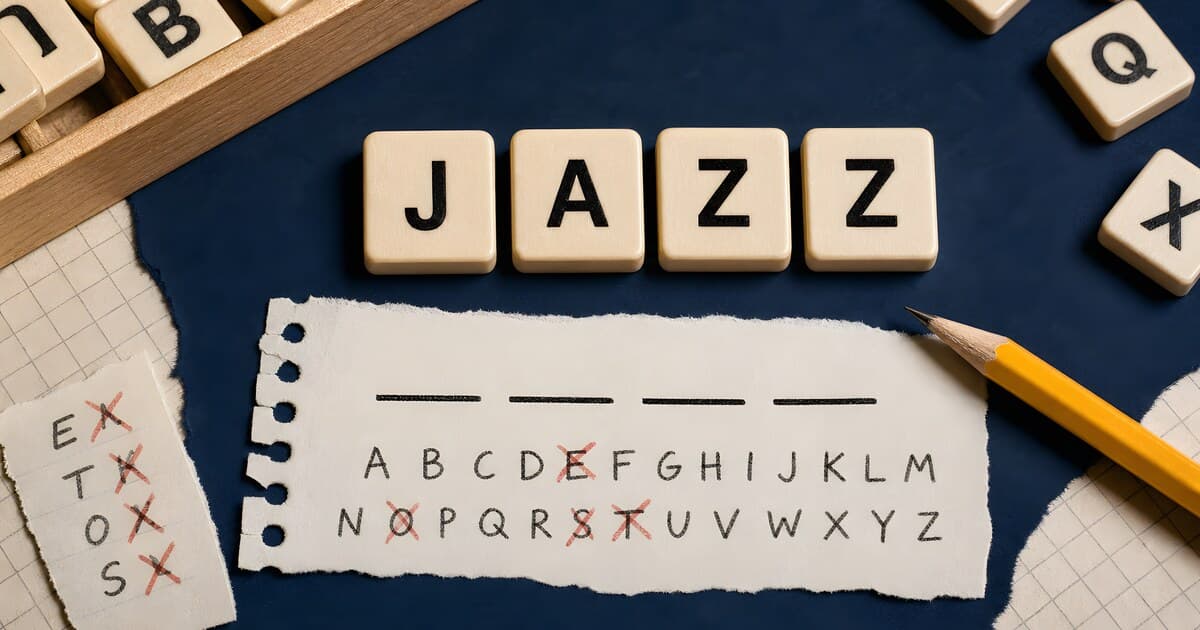
Jazz keeps beating sensible opening guesses. The hardest Hangman words tend to hide useful information behind rare letters, repeats, or a vowel pattern that refuses to behave. Start with jazz, syzygy, rhythm, lynx, myrrh, fizz, quiz, glyph, pizzazz, and coccyx when you need a quick challenge.
There are 120 family-friendly choices below. Each one is grouped by the spelling feature that makes it awkward, and every group can be loaded into our custom Hangman game maker. For a less punishing round, use the filters in the full Hangman word list.
15 hard Hangman words to try first
These give you a useful mix rather than fifteen variations of the same Z trick.
| Word | Main obstacle | Fair hint |
|---|---|---|
| jazz | J plus a repeated Z | A style of music |
| syzygy | Three Ys and no A, E, I, O, or U | An alignment in astronomy |
| rhythm | Y carries both vowel sounds | A repeated beat |
| lynx | Four short letters, ending in X | A wild cat |
| myrrh | Repeated R and an unusual spelling | An aromatic resin |
| fizz | One common vowel, then double Z | Bubbles and a soft sound |
| quiz | Q and Z in four letters | A short test |
| glyph | A consonant-heavy pattern | A carved or written symbol |
| pizzazz | Four Zs, with only three other letters | Energy and stylish flair |
| coccyx | Repeated C, then Y and X | The tailbone |
| kayak | Two As, two Ks, and Y | A narrow paddle boat |
| sphinx | A dense opening cluster and final X | A famous carved figure |
| zephyr | Z, Y, and a PH spelling | A gentle breeze |
| awkward | W and K break the familiar vowels | Clumsy or uncomfortable |
| twelfth | A compressed consonant ending | The position after eleventh |
Jazz has unusually strong evidence behind it. In 2010, Jon McLoone tested a large dictionary against an optimal computer strategy for Wolfram and found jazz was the toughest answer in that simulation. The method, dictionary, and other high-performing words are available in the original Wolfram Hangman analysis.
That result belongs to a defined computer experiment. A child who guesses J because the category is music can solve jazz quickly, while a specialist term may stop a human group even when its letters are common.
Why short Hangman words can stay hidden
A long answer gives the guesser more positions where a common letter might land. A four-letter word offers fewer openings. But length is only one part of the board.
Peter Norvig's analysis of a very large Google Books corpus places E, T, A, O, and I near the common end of English letter use. J, Q, X, and Z sit near the rare end. His English letter-frequency tables publish both the source and the counting details.
So an ordinary opening such as E or A is reasonable across general English. Words such as lynx and rhythm punish that habit because Y does work the guesser expected from a standard vowel. Repeated letters create another wrinkle. Guessing Z in fizz reveals two spaces, though it took only one decision to find both.
Our interactive list uses a transparent structural score from 0 to 100. It combines:
- letter rarity based on general English frequency
- Repeated characters. More repetition means fewer distinct letters to discover.
- A low share of A, E, I, O, and U raises the score.
- short answers receive a modest adjustment
The score calls jazz 57, rhythm 44, and xylophone 20. That is useful and imperfect. Rhythm can feel much harder than 44 to a player who spends four misses on vowels, while xylophone becomes easy after one lucky X. We publish the thresholds and limitations on the Hangman words page instead of presenting the number as a universal truth.
120 hardest Hangman words, grouped by the trap
Every group contains 15 unique answers. A few are genuinely obscure, so use the group notes and give a category hint when the word falls outside the players' shared vocabulary.
Rare letters packed into short words
jazz, buzz, fizz, whizz, quiz, jinx, lynx, onyx, vex, wax, fox, box, zinc, zeal, quirk
J, Q, X, and Z often arrive late in a frequency-first guessing strategy. The shortest answers here leave little room for a common letter to rescue the round.
Few standard vowels
rhythm, syzygy, myrrh, glyph, nymph, crypt, tryst, cyst, sync, hymn, lymph, sylph, dryly, wryly, flyby
Y behaves differently from word to word. Agree before play that every standard dictionary word is eligible, then offer a definition for sylph or syzygy. Recognition should remain part of the game rather than a surprise argument at the end.
Repeated-letter traps
pizzazz, razzmatazz, embezzle, puzzle, dazzle, sizzle, drizzle, fuzzy, dizzy, zipper, assess, banana, bookkeeper, committee, Mississippi
One correct letter may fill half the board. That feels generous, yet it also means the answer contains fewer unique letters than its length suggests. Mississippi is a proper place name, so save it for a geography category or a group that permits names.
Familiar words with odd shapes
kayak, kiosk, bagel, cocoa, onion, puppy, quiet, sheep, tooth, jelly, zebra, wagon, yacht, kiwi, igloo
Nobody needs a specialist dictionary for these. The difficulty comes from repeated vowels, unexpected consonants, and spellings such as yacht that reveal less than their pronunciation suggests.
Compact words with uncommon consonants
ajar, oxen, jury, ivory, proxy, vixen, gauze, topaz, khaki, squib, fjord, waltz, dwarf, wharf, sphinx
Khaki and squib can be fair with a clothing or vocabulary hint. A word setter should know the meaning and spelling of the answer before putting it on the board. Write it down privately, too.
Science and nature challenges
coccyx, enzyme, oxygen, quartz, zephyr, zodiac, galaxy, nebula, photon, syntax, axiom, matrix, vortex, quasar, zygote
This set works well for a science club or older classroom. It would be a rough opening round for younger children without categories, because subject knowledge carries as much weight as letter choice.
Longer words that keep their bite
xylophone, awkward, flapjack, jukebox, rickshaw, bagpipes, mnemonic, pneumonia, zigzagging, juxtapose, quicksilver, buckwheat, jackrabbit, earthquake, kaleidoscope
More blanks usually expose more common letters. These answers compensate with silent openings, rare consonants, or a structure that can suggest several plausible words. Mnemonic and pneumonia deserve pronunciation hints if players have mostly seen them in print.
Consonant clusters and tricky endings
twelfth, strengths, scratch, squawk, thrush, clutch, glimpse, prompt, branch, switch, blotch, shrink, phlegm, scythe, knight
Endings such as -tch and openings such as scr- become much easier once one part is visible. Before that point, a frequency list may have several equally sensible choices.
How to choose a hard Hangman word fairly
Difficulty should feel earned. Pick from vocabulary the players could recognize, write the answer before guessing begins, and give the category at the start. If the answer is a proper name, abbreviation, foreign word, or inflected form, say that in advance.
Use this small check:
- Can everyone reasonably know the word?
- Is the spelling settled in the variety of English you are using?
- Would a short category hint make the challenge clearer without revealing letters?
- Are spaces, apostrophes, and hyphens visible from the beginning?
The complete rules for Hangman cover whole-word guesses, miss limits, phrase spacing, team play, and a flower drawing for groups that prefer a gentler countdown.
How to solve hard Hangman words deliberately
Read the shape before spending a letter. A four-character answer and an eight-character answer should not get an identical opening merely because E is common across books.
- Start with a plausible family of words. Then choose a letter that separates those candidates.
- After several vowels miss, test Y. Rhythm, glyph, and myrrh remain possible while most ordinary words fall away.
- Repeated blank patterns matter once one copy is revealed.
_ A _ A _should make kayak and related structures easier to notice. - A category can outweigh raw frequency. X is reasonable early when the hint is musical instruments and the board has nine letters.
- Whole-word guesses need an agreed cost. A free guess after every letter can erase the challenge.
The Hangman solver is useful after a round. Rebuild the pattern, add the missed letters, and compare the candidate coverage. It draws from more than 8,000 general words, while clearly warning when names or specialist vocabulary may be absent.
Build a balanced Hangman word set
Ten rounds feel better when the spelling traps change. Choose two short rare-letter words, two familiar repeats, a science term that suits the group, and several medium challenges from another category. Put jazz near the end. Opening with it sets a rather severe baseline.
Paste one answer per line into the custom Hangman maker, or select a category and difficulty inside the free online Hangman game. Hints can follow each custom answer after a vertical bar, which lets another person host the set without seeing a separate answer sheet.